
| Matisse Discounted Closed-End Fund Strategy | |
|---|---|
| Ticker | MDCEX |
| Inception | 10/31/2012 |
| Morningstar® Category | Global Moderately Aggressive Allocation |
| Net Assets (3/31/26) | $64,859,363 |
| # of Holdings | 34 |
| Distribution Schedule | Monthly |
| Liquidity | Daily |
| Fees & Expenses | |
|---|---|
| Sales Load | None |
| Management Fee | 0.95% |
| Acquired Fund Fees & Expenses | 1.56% |
| Total Expense Ratio | 3.19% |
Why Invest in MDCEX?
- Monthly income and capital appreciation potential.
- Matisse believes MDCEX gives investors a statistical edge to outperform in the global financial markets and global moderately aggressive allocation category.
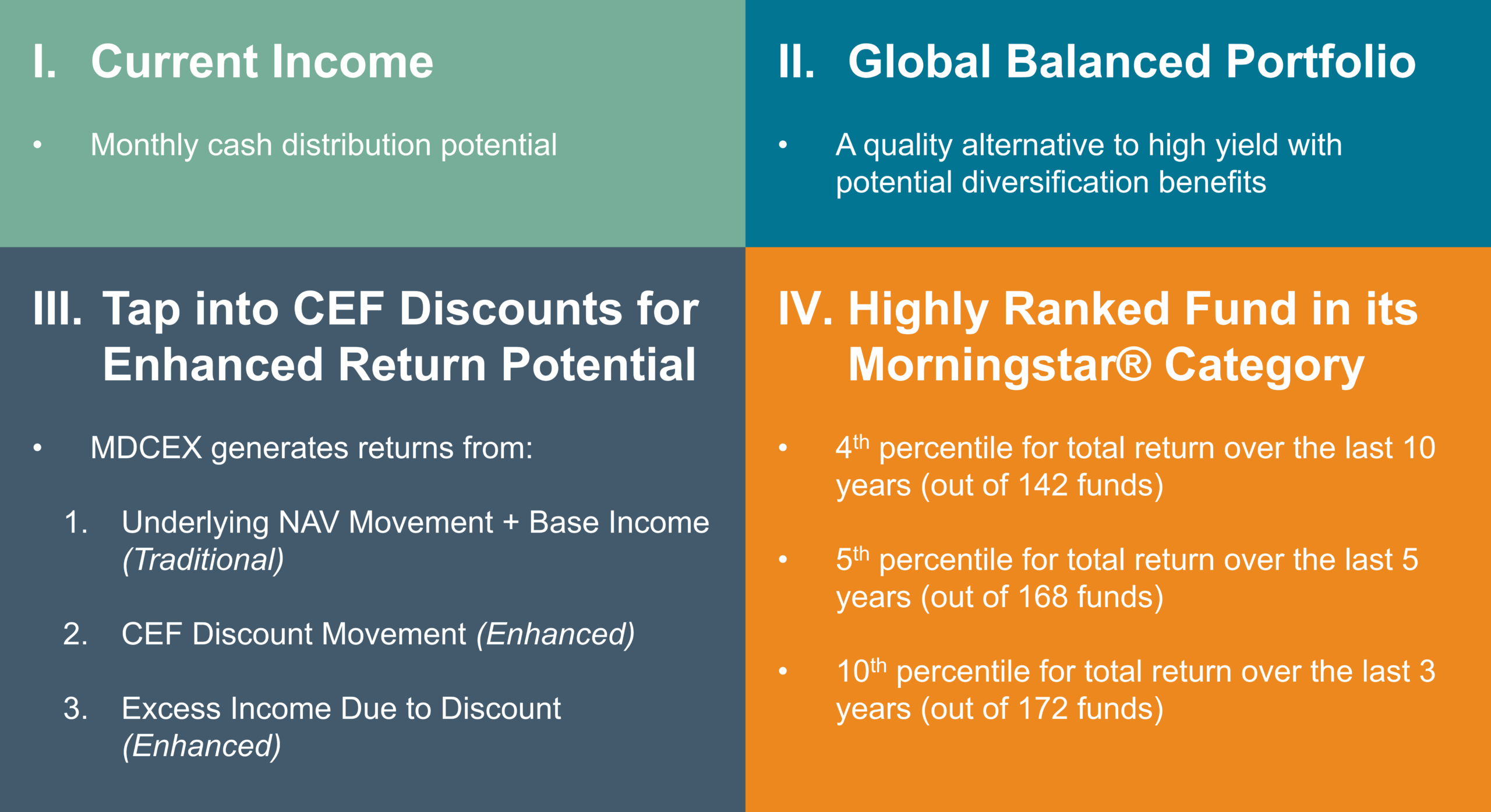
Average Discount of MDCEX Portfolio: -26.79%
Fund Documents
| As of 3/31/2026 | Morningstar Overall Rating™ | 3-Year Rating | 5-Year Rating | 10-Year Rating |
|---|---|---|---|---|
| Matisse Discounted Closed-End Fund Strategy (MDCEX) | ⭐⭐⭐⭐⭐ 5 Stars | ⭐⭐⭐⭐⭐ 5 Stars | ⭐⭐⭐⭐⭐ 5 Stars | ⭐⭐⭐⭐ 4 Stars |
| Number of Funds in Category | - | 172 | 168 | 142 |
Ratings based on risk adjusted returns. A fund's overall rating is derived from a weighted average of the performance figures associated with its 3-, 5- and 10-year (if applicable) rating metrics. †
†Source: Morningstar®. For each mutual fund and exchange traded fund with at least a 3-year history, Morningstar calculates a Morningstar Rating™ based on how a fund ranks on a Morningstar Risk-Adjusted Return measure against other funds in the same category. This measure takes into account variations in a fund’s monthly performance, and does not take into account the effects of sales charges and loads, placing more emphasis on downward variations and rewarding consistent performance. The top 10% of funds in each category receive 5 stars, the next 22.5% receive 4 stars, the next 35% receive 3 stars, the next 22.5% receive 2 stars and the bottom 10% receive 1 star. The weights are: 100% 3-year rating for 36–59 months of total returns, 60% 5-year rating/40% 3-year rating for 60–119 months of total returns, and 50% 10-year rating/30% 5-year rating/20% 3-year rating for 120 or more months of total returns. While the 10-year overall star rating formula seems to give the most weight to the 10-year period, the most recent 3-year period actually has the greatest impact because it is included in all three rating periods. Mutual fund Morningstar Ratings™ are for Class I, Z or Advisor Shares only; other classes may have different performance characteristics. Past performance is not an indicator or a guarantee of future performance. © 2026 Morningstar, Inc. All rights reserved. The information contained herein is proprietary to Morningstar and/or its content providers; may not be copied or distributed; and is not warranted to be accurate, complete or timely. Neither Morningstar nor its content providers are responsible for any damages or losses arising from any use of this information.
Performance (Net After All Fees)
| Performance (as of 3/31/2026) | YTD | 1-Year | 3-Year | 5-Year | 10-Year | Since Inception MDCEX 10/31/2012 (annualized) |
|---|---|---|---|---|---|---|
| MDCEX | -2.76% | 20.73% | 18.86% | 13.08% | 11.39% | 9.33% |
| Morningstar Category Average | 0.32% | 17.96% | 13.12% | 7.15% | 8.73% | 8.17% |
| % Rank in Morningstar Category | — | 11th | 10th | 5th | 4th | — |
| # of Funds in Morningstar Category | 177 | 177 | 172 | 168 | 142 | — |
| Morningstar Global Allocation Index | -2.07% | 13.96% | 11.18% | 5.29% | 7.39% | 6.96% |
| S-Network Composite Closed-End Fund Total Return Index | -2.91% | 9.05% | 11.02% | 4.60% | 7.18% | 6.33% |
| First Trust Composite Closed-End Fund Index | -1.37% | 10.85% | 11.83% | 4.90% | 6.99% | 5.80% |
Returns longer than one year are annualized. The performance information quoted represents past performance, which is not a guarantee of future results. Investment return and principal value of an investment will fluctuate so that an investor’s shares, when redeemed, may be worth more or less than their original cost. Current performance may be lower or higher than the performance data quoted. For performance current to most recent month-end, please send a request to info@matissecap.com, or call Shareholder Services at 1-800-773-3863. The Total Annual Fund Operating Expense for the Fund as disclosed in the prospectus is 3.19% dated August 1, 2025. Total return measures net investment income and capital gain or loss from portfolio investments. All performance shown assumes reinvestment of dividends and capital gains distributions. There is no guarantee that the Fund will pay or continue to pay distributions.
Performance data for periods prior to August 1, 2024, reflects a management fee of 0.99% and an expense limit of 1.25% for MDCEX.
Percentile rank was generated by Morningstar® and includes all share classes for funds with multiple share classes. Ranking information was based on total return, and some fees were waived during the period per the Advisor’s previous expense limitation agreement with the Fund.
Yield (Net After All Fees)
| Yield (as of 3/31/2026) | Distribution Schedule | Distribution Amount | Distribution Rate | Estimated Return of Capital | 30-Day SEC Yield |
|---|---|---|---|---|---|
| MDCEX | Monthly | $0.044 / share | 7.18% | 0.00% | 4.63% |
Distribution Rate is calculated by annualizing actual distributions for the monthly period ended on the date shown and dividing by the net asset value on the last business day for the same period. Distributions include capital gains distributions.
Why Matisse Funds
- Investor in CEFs since 2000.
- CEF research, investing, and trading is a core focus.
- Portfolio managers have a deep understanding of risk management techniques and
strategies for building CEF portfolios. - Proprietary live NAV modeling database.
- Long familiarity with behavior of major players and actors in the CEF space.
- Extensive trading network and a go-to firm for many CEF brokers.
Exploiting CEF Inefficiencies
Potential Return Catalysts --- How Matisse Wins
Discount Mean Reversion
- Matisse proprietary quantitative model attempts to forecast the (i) speed, (ii) size, and (ii) probability of discount narrowing for any individual CEF issue
- Portfolio managers select CEFs that are best positioned to experience future discount narrowing
- Capture the return from discount movement upon exiting a CEF position
Corporate Actions
- Matisse may pursue investments in CEFs that have announced (or are likely to announce) certain corporate actions
- Focus on taking advantage of favorable CEF tender offers, rights offerings, shareholder distributions, openendings / liquidations, and IPOs
Extra Income
- When you purchase a CEF trading at a discount, your effective yield increases because CEFs still pay out distributions AT-NAV
- Matisse takes a patient approach with CEF positions, and benefits from enhanced yields while waiting for discounts to move
Institutional Ownership
- Matisse monitors institutional ownership of CEFs closely
- Institutional owners can impact CEF discount levels through several catalysts (including merger activity and activism campaigns)
- While Matisse is not an activist, we monitor and assess opportunities created by other institutional owners who are
Investment Rationale
- Limited capacity, value-oriented investment strategy focused on discounted CEFs.
- Pricing inefficiencies in the CEF market are largely driven by:
- Mechanics of CEF structure and trading.
- Behavioral factors relating to fear and greed (emotions of a retail-dominated investor base).
- Low institutional participation.
- Majority of players in CEF market are discount insensitive.
- "Flow-based" vs. "value-based" investment decisions.
- MDCEX seeks to take advantage of the strong mean reverting tendencies of CEF discounts.
- Open-end fund structure pays out anticipated monthly cash distributions to shareholders.
- Provides complementary exposure to both equity and fixed income asset classes.
- Differentiated alpha proposition stemming from changes in CEF discounts / premiums to NAV.
Investment Process

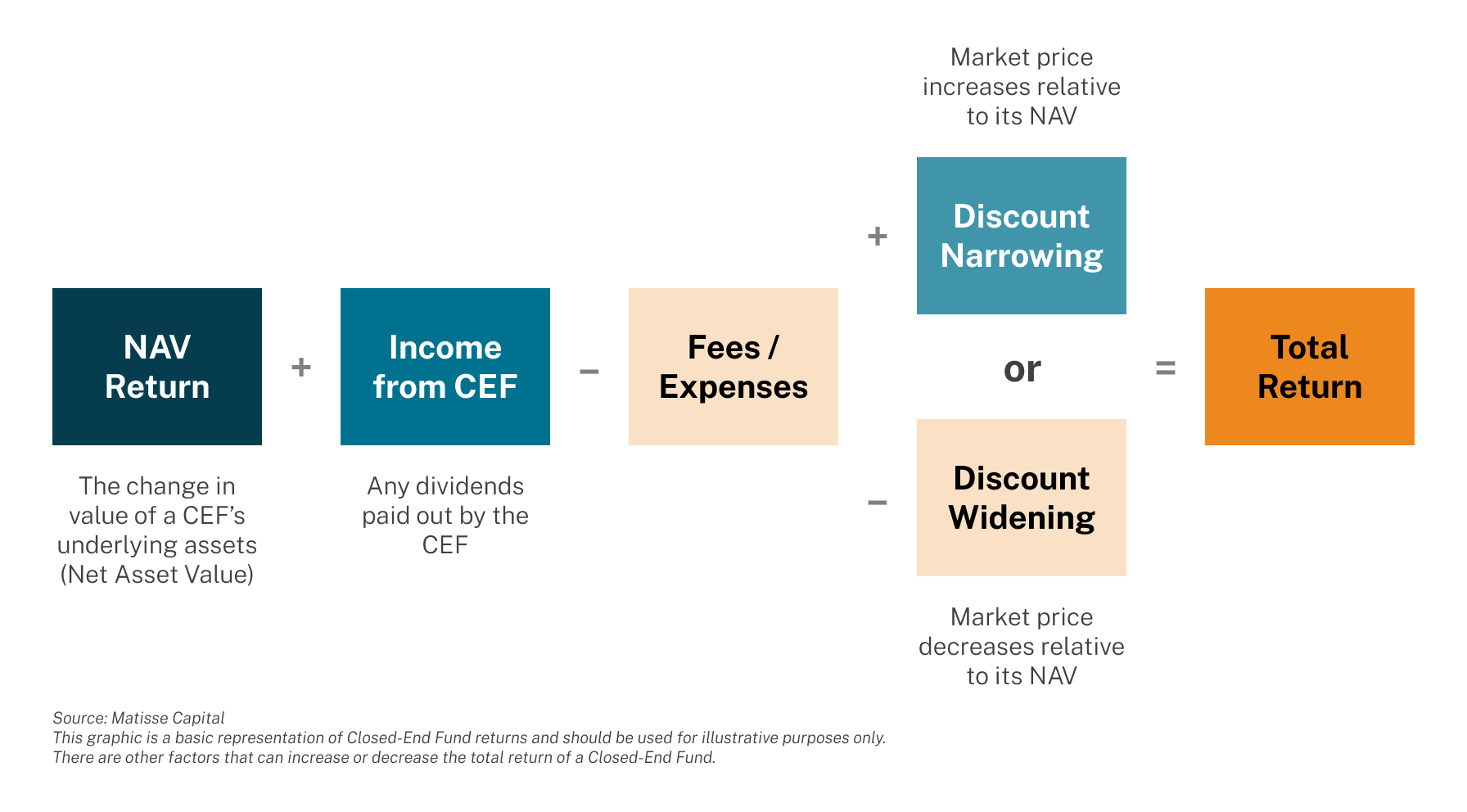
Understanding CEF Returns
Portfolio Management Team

Bryn Torkelson
Bryn is the founder and president of Matisse Capital, the adviser to Matisse Funds, and has 40 years of investment industry experience, including deep roots on the investment advisory side with institutional investors, family offices, foundations, and individuals. After more than a decade of work devoted to portfolio management and research in the closed-end fund space, Bryn launched the Matisse Discounted Closed-End Fund Strategy (MDCEX) in 2012 and serves as Co-Portfolio Manager. Bryn also serves as Co-Portfolio Manager of the Matisse Discounted Bond CEF Strategy (MDFIX), which was launched in 2020. Prior to founding Matisse Capital, he was senior vice president, managing partner, and perennial Chairman’s Club member at Dain Bosworth, Inc. (a former NYSE company), where he worked for 10 years. He started his investment career at Smith Barney Harris Upham in Seattle. He received a BS degree in finance from the University of Oregon in 1980.

Eric Boughton, CFA
Eric joined Matisse in 2006 and serves as the Co-Portfolio Manager and Chief Analyst for both MDCEX and MDFIX. Previously, Eric was a Portfolio Manager and Analyst with 1st Source, where he also co-managed a publicly traded mutual fund. Eric has worked extensively in the closed-end fund space, on both the research and portfolio management side, including discounted closed-end fund separate account management for Matisse advisory clients prior to the launch of MDCEX. Eric received a BS degree with distinction in mathematics from the University of Houston in 1997. He is a Registered Investment Advisor, and is a CFA charter holder.
Annual Fund Expenses
Understanding the fees you pay in a “fund of funds” can be confusing, and the SEC requires that the operating expense of MDCEX includes the operating expenses of its underlying holdings. The bottom line is that we cap our direct management fee on MDCEX at 0.95%.
Think our fund expenses look high? Before you jump to conclusions, learn more about why our expenses look high.
| Expense | MDCEX | Expense Description |
|---|---|---|
| Advisor Management Fees | 0.95% | The Advisor (Matisse Capital) receives a monthly management fee equal to a maximum of 0.95% of the Fund’s net assets. |
| Distribution and/or Service (12b-1) Fees | None | Fees paid out of the Fund to cover the costs of distribution (marketing and selling shares of the Fund). The Fund has no fees related to distribution and/or service (12b-1). |
| Other Expenses | 0.58% | Expenses related to the operation of the Fund, including professional fees, administration fees, registration and filing expenses, Fund accounting fees, transfer agent fees, custody fees, shareholder fulfillment expenses, compliance fees, trustee fees and meeting expenses, miscellaneous expenses, security pricing fees, and insurance fees. The Advisor (Matisse Capital) does not collect any of these fees. |
| Interest Expense on Borrowings | 0.10% | Interest expense incurred by the Fund on amounts borrowed. The Advisor (Matisse Capital) does not collect any of these fees. Interest expense is charged directly to the Fund based upon actual amounts borrowed by the Fund. |
| Acquired Fund Fees and Expenses | 1.56% | The operating expenses of the Fund’s underlying investments in closed-end funds and other investment companies. These fees are not a cash expense of the Fund. The Advisor (Matisse Capital) does not collect any of these fees. Acquired Fund Fees and Expenses do not affect a Fund’s actual operating costs, and therefore are not included in the Fund’s financial statements, which provide a clearer picture of a Fund’s actual operating costs. The operating expenses in this fee table will not correlate to the expense ratio in the Fund’s financial statements, once available, because the financial statements include only the direct operating expenses incurred by the Fund. |
| Total Annual Fund Operating Expenses | 3.19% | The Fund’s costs as a percentage of the Fund’s total assets, before any fee waiver and/or expense limitation. The Total Annual Fund Operating Expense is required to include Acquired Fund Fees and Expenses. The Advisor (Matisse Capital) receives a monthly management fee equal to a maximum of 0.95% of the Fund’s net assets. |
As of the Fund's prospectus dated August 1, 2025.
Principal Risks of Investing in the Fund Disclosure
The loss of your money is a principal risk of investing in the Fund. Investments in the Fund are subject to investment risks, including the possible loss of some or the entire principal amount invested. An investment in the Fund is not a deposit or obligation of any bank, is not endorsed or guaranteed by any bank, and is not insured by the Federal Deposit Insurance Corporation or any other government agency. There can be no assurance that the Fund will be successful in meeting its investment objective. Generally, the Fund will be subject to the following principal risks:
Closed-End Fund Risk. Closed-end funds involve investment risks different from those associated with other investment companies. First, the shares of closed-end funds frequently trade at a premium or discount relative to their net asset value. When the Fund purchases shares of a closed-end fund at a discount to its net asset value, there can be no assurance that the discount will decrease, and it is possible that the discount may increase and affect whether the Fund will realize a gain or loss on the investment. Second, many closed-end funds use leverage, or borrowed money, to try to increase returns. Leverage is a speculative technique and its use by a closed-end fund entails greater risk and leads to a more volatile share price. If a closed-end fund uses leverage, increases and decreases in the value of its share price will be magnified. The closed-end fund will also have to pay interest or dividends on its leverage, reducing the closed-end fund’s return. Third, many closed-end funds have a policy of distributing a fixed percentage of net assets regardless of the fund’s actual interest income and capital gains. Consequently, distributions by a closed-end fund may include a return of capital, which would reduce the fund’s net asset value and its earnings capacity. Finally, closed-end funds are allowed to invest in a greater amount of illiquid securities than open-end mutual funds. Investments in illiquid securities pose risks related to uncertainty in valuations, volatile market prices, and limitations on resale that may have an adverse effect on the ability of the fund to dispose of the securities promptly or at reasonable prices.
Fund of Funds Risk. The Fund is a “fund of funds.” The term “fund of funds” is typically used to describe investment companies, such as the Fund, whose principal investment strategy involves investing in other investment companies, including closed-end funds and money market mutual funds. Investments in other funds subject the Fund to additional operating and management fees and expenses. For instance, investors in the Fund will indirectly bear fees and expenses charged by the funds in which the Fund invests, in addition to the Fund’s direct fees and expenses. The Fund’s performance depends in part upon the performance of the funds’ investment advisor, the strategies and instruments used by the funds, and the Advisor’s ability to select funds and effectively allocate Fund assets among them.
Control of Closed-End Funds Risk. Although the Fund and the Advisor will evaluate regularly each closed-end fund in which the Fund invests to determine whether its investment program is consistent with the Fund’s investment objective, the Advisor will not have any control over the investments made by a closed-end fund. The investment advisor to each closed-end fund may change aspects of its investment strategies at any time. The Advisor will not have the ability to control or otherwise influence the composition of the investment portfolio of a closed-end fund.
Fixed Income Securities Risk. When the Portfolio Funds invest in fixed income securities, the value of your investment in the Fund will fluctuate with changes in interest rates. Typically, a rise in interest rates causes a decline in the value of fixed income securities. In general, the market price of fixed income securities with longer maturities will increase or decrease more in response to changes in interest rates than shorter-term securities. Other risk factors include credit risk (the debtor may default), extension risk (an issuer may exercise its right to repay principal on a fixed rate obligation later than expected), and prepayment risk (the debtor may pay its obligation early, reducing the amount of interest payments). These risks could affect the value of a particular investment by the Fund, possibly causing the Fund’s share price and total return to be reduced and fluctuate more than other types of investments.
Investment Risk. Various sectors of the global financial markets have been experiencing an extended period of adverse conditions. Market uncertainty has increased dramatically, particularly in the United States and Europe, and adverse market conditions have expanded to other markets. These conditions have resulted in disruption of markets, periods of reduced liquidity, greater volatility, general volatility of spreads, an acute contraction in the availability of credit and a lack of price transparency. The long-term impact of these events is uncertain but could continue to have a material effect on general economic conditions, consumer and business confidence, and market liquidity.
Major public health issues, such as COVID-19, have at times, and may in the future impact the Fund. The COVID-19 pandemic caused substantial market volatility and global business disruption and impacted the global economy in significant and unforeseen ways. Any public health emergency, including the COVID-19 pandemic or any outbreak of other existing or new epidemic diseases or the threat thereof, and the resulting financial and economic market uncertainty, could have a material adverse impact on the Fund or its investments. Moreover, changes in interest rates, travel advisories, quarantines and restrictions, disrupted supply chains and industries, impact on labor markets, reduced liquidity or a slowdown in U.S. or global economic conditions resulting from a future public health crisis may also adversely affect the Fund or its investments. COVID-19, or any other health crisis and the current or any resulting financial, economic and capital markets environment, and future developments in these and other areas present uncertainty and risk with respect to the Fund’s NAV, performance, financial condition, results of operations, ability to pay distributions, make share repurchases and portfolio liquidity, among other factors.
Economic problems in a single country are increasingly affecting other markets and economies, and a continuation of this trend could adversely affect global economic conditions and world markets. Uncertainty and volatility in the financial markets and political systems of the U.S. or any other country, including volatility as a result of the ongoing conflicts between Russia and Ukraine and Israel and Hamas and the rapidly evolving measures in response, may have adverse spill-over effects into the global financial markets generally.
Cybersecurity Risk. As part of its business, the Advisor processes, stores, and transmits large amounts of electronic information, including information relating to the transactions of the Fund. The Advisor and the Fund are therefore susceptible to cybersecurity risk. Cybersecurity failures or breaches of the Fund or its service providers have the ability to cause disruptions and impact business operations, potentially resulting in financial losses, the inability of Fund shareholders to transact business, violations of applicable privacy and other laws, regulatory fines, penalties, and/or reputational damage. The Fund and its shareholders could be negatively impacted as a result.
Equity Securities Risk. Fluctuations in the value of equity securities held by the Portfolio Funds will cause the NAV of the Fund to fluctuate. Equity securities may decline in price if the issuer fails to make anticipated dividend payments. Common stock is subject to greater dividend risk than preferred stocks or debt instruments of the same issuer. In addition, equity securities have experienced significantly more volatility in returns than other asset classes.
Foreign Securities Risk. The Fund may invest in foreign securities. Foreign securities involve investment risks different from those associated with domestic securities. Changes in foreign economies and political climates are more likely to affect the Fund than investments in domestic securities. The value of foreign currency denominated securities or foreign currency contracts is affected by the value of the local currency relative to the U.S. dollar. There may be less government supervision of foreign markets, resulting in non-uniform accounting practices and less publicly available information about issuers of foreign currency denominated securities. The value of foreign investments may be affected by changes in exchange control regulations, application of foreign tax laws (including withholding tax), changes in governmental administration or economic or monetary policy (in this country or abroad) or changed circumstances in dealings between nations. In addition, foreign brokerage commissions, custody fees, and other costs of investing in foreign securities are generally higher than in the United States. Investments in foreign issues could be affected by other factors not present in the United States, including expropriation, armed conflict, confiscatory taxation, and potential difficulties in enforcing contractual obligations.
ADR Risk. ADRs may be subject to some of the same risks as direct investments in foreign companies, which includes international trade, currency, political, regulatory, and diplomatic risks. In a sponsored ADR arrangement, the foreign issuer assumes the obligation to pay some or all of the depository’s transaction fees. Under an unsponsored ADR arrangement, the foreign issuer assumes no obligations and the depository’s transaction fees are paid directly by the ADR holders. Because unsponsored ADR arrangements are organized independently and without the cooperation of the issuer of the underlying securities, available information concerning the foreign issuer may not be as current as for sponsored ADRs and voting rights with respect to the deposited securities are not passed through.
General Investment Risks. All investments in securities and other financial instruments involve a risk of financial loss. No assurance can be given that the Fund’s investment program will be successful. Investors should carefully review the descriptions of the Fund’s investments and their risks described in this prospectus and the Fund’s Statement of Additional Information.
Investment Advisor Risk. The Advisor’s ability to choose suitable investments has a significant impact on the ability of the Fund to achieve its investment objectives.
Quantitative Model Risk. Securities or other investments selected using quantitative methods may perform differently from the market as a whole. There can be no assurance that these methodologies will enable the Fund to achieve its objective.
Leverage Risk. The Fund may leverage or borrow money from banks to buy securities and pledge its assets in connection with the borrowing. Use of leverage tends to magnify increases and decreases in the Fund’s returns and leads to a more volatile share price. The Fund will also incur borrowing costs in connection with its use of leverage. If the interest expense of the borrowing is greater than the return on the securities bought, the use of leverage will decrease the return to shareholders in the Fund. Leveraging by both the Fund and the underlying closed-end funds, which often employ leverage, will expose the Fund to a relatively high level of leverage risk. There can be no assurance that a leveraging strategy will be successful during any period in which it is employed.
Loans Risk. Investments in loans may subject the Fund to heightened credit risks because loans may be highly leveraged and susceptible to the risks of interest deferral, default, and/or bankruptcy.
Management Style Risk. Different types of securities tend to shift into and out of favor with investors depending on market and economic conditions. The returns from the types of investments purchased by the Fund (e.g., closed-end funds which pay regular periodic cash distributions) may at times be better or worse than the returns from other types of funds. Each type of investment tends to go through cycles of performing better or worse than the market in general. The performance of the Fund may thus be better or worse than the performance of funds that focus on other types of investments, or that have a broader investment style.
Market Risk. Market risk refers to the possibility that the value of securities held by the Fund may decline due to daily fluctuations in the market. Market prices for securities change daily as a result of many factors, including developments affecting the condition of both individual companies and the market in general. The price of a security may even be affected by factors unrelated to the value or condition of its issuer, such as changes in interest rates, economic and political conditions, and general market conditions. The Fund’s performance per share will change daily in response to such factors.
Money Market Mutual Fund Risk. The Fund may invest in money market mutual funds in order to manage its cash component. An investment in a money market mutual fund is not insured or guaranteed by a Federal Deposit Insurance Corporation or any other government agency. Although such funds seek to preserve the value of the Fund’s investment at $1.00 per share, it is possible to lose money by investing in a money market mutual fund.