
Quick Links
What is a Closed-End Fund?
A closed-end fund is a publicly-traded fund of investment assets that has a set number of shares. Like stock for a company, a CEF has an initial public offering (IPO) which sets the initial price of the predetermined number of shares of the fund. Shares are then bought and sold on an exchange, like a stock.
Closed-end funds differ from open-end funds -- or traditional mutual funds -- in two main ways:
- CEFs have a set number of shares, whereas open-end funds create new shares each time a shareholder invests
- CEFs are traded on exchanges, with prices changing throughout the day based on supply and demand, while open-end funds are only transacted once a day at the closing net asset value (NAV)
Key CEF Terminology
- NAV
- net asset value per share of the fund’s portfolio
- Market Price
- the price at which shares are trading on the exchange, which can be different than the NAV
- Discount
- when the market price is lower than the NAV
- Premium
- when the market price is higher than the NAV
Advantages of Closed-End Funds
We believe closed-end funds have three potential advantages over other fund types, including income potential, diversification, and flexibility.
Income from Investments
CEFs are designed and managed to distribute large portions of the returns that they make. In general, one main goal of the professional managers of a CEF is to provide shareholders with consistent distributions, which are often tax-advantaged, on a monthly or quarterly basis.
Diversified Assets
CEFs can invest in a wider range of assets than open-end funds, which may include investments in less liquid markets or securities, micro-cap investments, and alternative assets. This can help investors diversify their overall portfolios while still offering an income-focused strategy.
Flexible Tactics
Because CEFs aren’t dealing with a fluctuating number of shares, they aren’t required to keep as much liquid capital to fulfill sales of shares. Instead, they can leverage assets within their portfolio and take a long-term view on the health of the fund, potentially producing higher income for shareholders.
Types of Closed-End Funds
There are three main types of closed-end funds: Perpetual Funds, Term Funds, and Target Term Funds.
Perpetual Funds
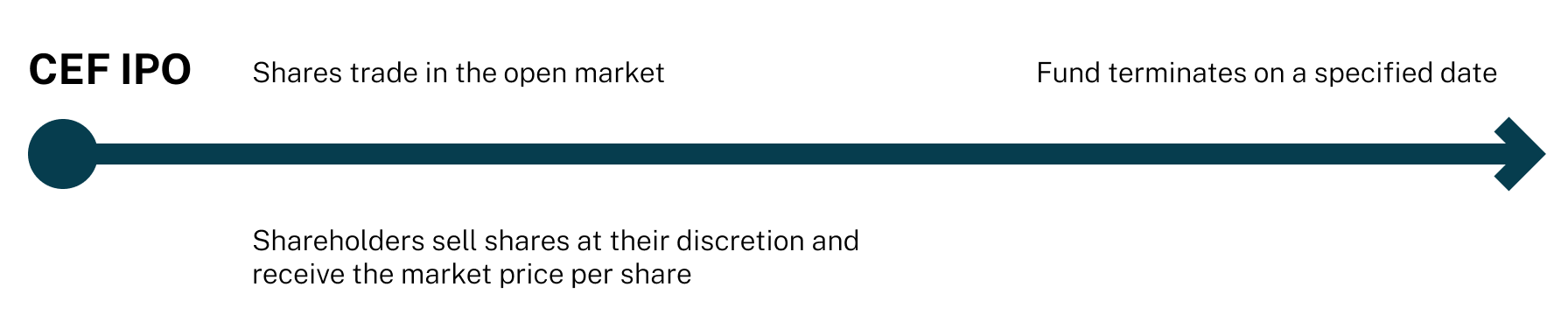
Perpetual CEFs don’t have a termination date, meaning there is no point at which shareholders are forced to sell their shares. Instead, when an investor wants to exit the investment, they sell their shares on the exchange at the market price. The current market price can be more or less than what they paid for the shares of the CEF. If the market price is at a premium compared to when they purchased the shares, the investors can make a profit when they sell their shares.
Why invest in a Perpetual CEF?
Perpetual CEFs give investors the freedom to choose when to sell their shares or to hold them indefinitely as a potential income-generating asset. This is also the most common form of CEFs, providing more choices in strategy and asset classes for investors.
Term Funds
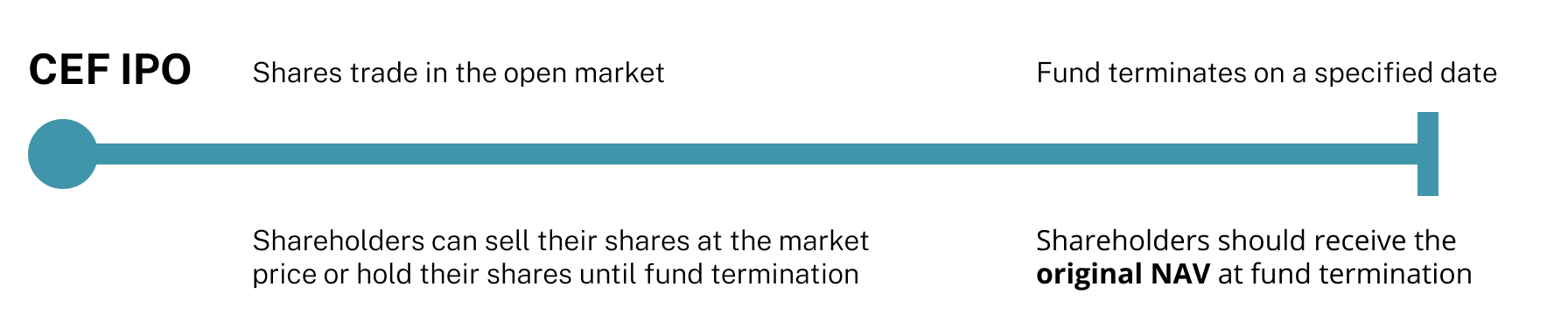
Term CEFs have a termination date. On this date, the fund terminates and shareholders receive a cash payment equivalent to the NAV per share that day. If the NAV is higher than what they paid for the shares, they can make a profit from their investment.
Why invest in a Term CEF?
A Term CEF can be advantageous for investors who have specific timelines and investment goals that align with the fund termination. CEF NAVs are typically more predictable than CEF share prices set in the market, so a Term CEF can potentially provide more certainty and security of return than trading a Perpetual CEF.

Target Term Funds
Like Term CEFs, Target Term CEFs have a specific date on which the fund terminates and shareholders receive a cash payment. However, in a Target Term CEF, the fund is managed to return a target NAV back to the shareholders.
Most Target Term CEFs aim to return the NAV at the IPO, meaning that if you owned shares at the inception of the fund, you would receive the same amount of money when the fund terminates. Between IPO and termination, shares are bought and sold on an exchange the same as other CEFs.
If you buy Target Term CEF shares on an exchange at a discount to the NAV at IPO, you have the option to hold them until the fund terminates. If cash is subsequently returned at the NAV at IPO, you could potentially make a profit on the investment.
Why invest in a Target Term CEF?
Investing in a Target Term CEF has similar benefits to investing in a Term CEF, with one key difference: the target NAV at termination might make these funds even more attractive to investors looking for stable, predictable returns.
Leverage and CEFs
One of the biggest potential advantages CEFs have over other types of funds is their ability to leverage the assets in their portfolio to make additional investments for longer-term profits. This benefit stems from the set number of shares established through an IPO, meaning the fund doesn’t have to keep liquid assets to pay shareholders if they want to sell their shares.
With nearly three-quarters of CEFs leveraging assets within their funds, it is by far the most common way for CEF managers to increase the potential for returns.
What is leverage?
Leveraging is the act of borrowing money against assets within a fund at a lower, short-term interest rate, then re-investing that money into longer-term securities. By doing this, the fund managers have the potential to earn higher returns on longer-term investments than they are paying in interest on the short-term loan.
How do CEFs leverage themselves?
CEFs create leverage in two common ways: by borrowing at short-term rates or by issuing senior securities or preferred shares of the fund that pay dividends at short-term rates. Sometimes portfolio leverage is also used--holding certain kinds of investments in the portfolio.
If the fund’s leverage strategy is successful, it will return higher distributions or total returns to common shareholders than they would normally have, after accounting for the added costs of leveraging.
That said, leverage can increase the volatility of a fund’s NAV, and may also impact the distributions and market price as well.
Leverage strategies and their impact
CEFs can choose to employ the leverage strategies below, sometimes concurrently, each with their own benefits and drawbacks.
Regulatory Leverage
This strategy changes a fund’s capital structure through the issuing of preferred shares or debt. It’s important to remember that both have higher priority of claims to the fund’s assets, meaning debt and preferred shareholders are paid their dividends before distributions can be paid to common shareholders.
Preferred shares and debt are limited by the Investment Company Act of 1940 to maximums of 50% and 33 ⅓% of the fund’s assets respectively.

Debt (Borrowings) Leverage
Usually involving a loan or other debt arrangement with a bank or institutional lender to the fund, debt leverage is reported as part of the fund’s expenses. This means that debt can also work in conjunction with certain fund income and can potentially reduce tax liabilities of distributions for common shareholders.
Debt leverage is often employed when the fund expects its capital to appreciate or become volatile in the long term.
Preferred Shares Leverage
CEF preferred share dividend rates are usually comparable to other short-term rates. They can be fixed or floating (adjustable), and are the primary cost associated with this kind of leverage. Preferred shares are rated similarly to other investments, with higher ratings resulting in lower dividends and lower overall costs to common shareholders.
Portfolio Leverage
Portfolio leverage refers to assets and securities that are themselves leveraged. For instance, some futures, forwards, and swaps are inherently leveraged, creating a new kind of leverage for the CEF when added to their portfolio. The benefit of portfolio leverage comes in the form of lower costs and efficient management, which may help increase the exposure of a fund that is larger than the amount the fund has invested.
How Return of Capital from CEFs Works
One of the biggest benefits a CEF can bring to a portfolio is the intersection of diversification and potential distribution income. Regular distributions are a core focus of CEFs and that income can take a few forms: interest income, dividends, realized capital gains, and return of capital.
There are three important concepts to consider when evaluating a fund’s distributions:
1. The fund's capital is made up of more than what you may have invested
The amount of capital at a fund’s disposal is determined by the initial investment by common shareholders at the fund’s inception. This is the initial NAV, and that NAV changes as assets in the fund appreciate, depreciate, or generate and distribute income. After expenses, the remaining return on that NAV is its income and gains.
Income from net investment income and realized gains are required by law to be distributed to shareholders every year. If this is the total amount the fund distributes throughout the year, the NAV will increase by whatever the amount of the unrealized capital appreciation is plus the initial investment.
Fixed income strategies prioritize the net investment income, meaning they distribute most of the money gained in a year and the NAV is only mildly affected by unrealized capital gains.

2. Returning capital from unrealized appreciation and the initial investment is a choice
Some funds may have returns made up primarily of appreciation, rather than income.
This may be because the fund wants to be more competitive in the market and attract more buyers or simply because it fits with the fund's goal of converting as much return as possible into shareholder distributions. If the fund chooses to pay a greater-than-required distribution amount, it has two options.
The first option the fund has is to realize a portion or all of its appreciation by selling portfolio assets. Doing this can increase the amount it distributes to shareholders.
Selling securities results in at least two outcomes:
- Realized gains are taxed in the current tax year
- The fund loses the potential for future appreciation of those assets in favor of immediate income
If a fund does not want either of those outcomes to occur, it can choose a second option: to pay additional distributions out of the capital of its portfolio -- the original investment in the fund plus unrealized gains.
Both options are considered return of capital (RoC).
What impact is there if a distribution includes RoC?
- RoC distributions will contain a certain amount of initial investment capital if they are greater than the unrealized gains of the fund. If this happens in perpetuity, the fund’s assets and earning potential will diminish over time.
- Cash is required to pay larger distributions over realized gains and interest income, which can come from many sources. One common source is by selling a security with less long-term potential.
- RoC is not taxed in the current year as income from selling securities would be. Instead, it reduces the cost basis of shareholders, so when they sell shares the gains are considered against the lower cost basis. The effect is usually some deferred tax liability for the shareholder.

3. Evaluating a fund based on RoC
There are several situations in which a fund would want to distribute RoC, tax benefit diminished invested principle, or both. Managed distribution programs seek to match distributions and returns over a longer period of time to guard shareholder’s investments. This means it is important to compare a fund’s distribution rate on NAV to the total return on NAV.
If the fund’s total return exceeds distributions, RoC may be distributed to defer tax liability.